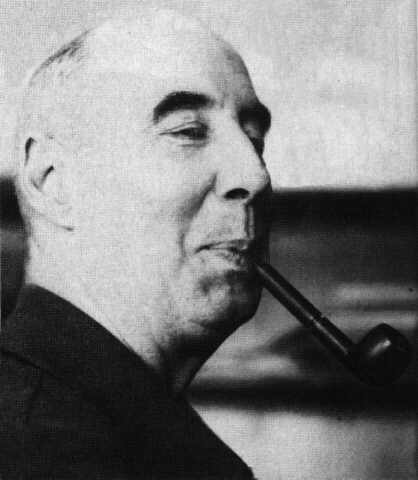
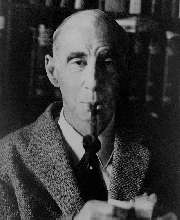
(born February 1, 1905, in Basel; deceased September 4, 1984, in Geneva).
If your search the Internet and physics literature, you will find the following anecdotes about this physicist:
--With his student, Andre Petermann, he invented 1951 the renormalization group, which is now essential to the construction of grand unified theories, and for which Kenneth Wilson later won a physics Nobel Prize.
To be exact, I have to mention that André Petermann informed me via e-mail on January 21, 2007, that:
"I was not really a student of Stueckelberg, but a recently graduate mathematician working on direct products of generalized functions and on the space on wich they can be defined. Stueckelberg, having such a problem with his student T.A.Green, in the work they were doing in S-matrix theory, asked me if I would be interested in working at the Swiss Atomic Energy Commission, in order to deal with this problem in a mathematical way, according to Schwartz, Sobolev and others. I took the job, and Stueckelberg became more my boss than my professor and later my beloved friend. I worked there during three years, leaving (on the advice of Stueckelberg) to go to Niels Bohr in Copenhagen. Best regards, André Petermann.
---------------------------------------------------------------------------------------
This is not yet the full story... concerning the renormalization group,read more at the bottom of the page !
---------------------------------------------------------------------------------------
--He predicted the first of the hundreds of subatomic particles discovered shortly before and after the war (World War II - the pion), but did not publish the idea after Pauli told him it was ridiculous. Later, the Japanese physicist Hideki Yukawa received a Nobel Prize for this idea.
--He pointed out in 1941 that pair production could be described classically by considering positrons as electrons running backwards in time.
--He illustrated these concepts with graphs of space-time trajectories similar to the diagrams Feynman began drawing in the summer of 1947.
--Richard Feynman won the Nobel Prize in phyiscs for 1965, jointly with Julian Schwinger of Harvard and Sin-Itiro Tomonoga of Japan. After the Nobel award ceremonies Feynman went to CERN to give a lecture. Feynman's lecture at CERN was attended by Ernst C. G. Stueckelberg. After the lecture, Stueckelberg was making his way out alone from the CERN amphitheatre, when Feynman - surrounded by admirers - made the remark:
"He did the work and walks alone toward the sunset; and, here I am, covered in all the glory, which rightfully should be his!"
Via anonymous email somebody informed me about the following anecdote:
After Feynman won the Nobel Prize, Schwinger called him up and asked: "Now are you going to give Stueckelberg his notes back?"
(The unknown author: This is anecdotal from a friend who is a theoretical physicist living in Boston whom I have known for 35 years. He told me this several years ago and I believe it to be true.)
I think that the main problem lies in the fact that Stueckelberg did not promote his ideas in a sufficient way. His article "La normalisation des constantes dans la theorie des quanta" (Helv. Phys. Acta 26, 499, 1953) gives a clear definition of the renormalization group concept, but the importance of his discovery remains unclear. There is an even older work on the subject together with T.A. Green (HPA 24, 153, 1951, "Elimination des constantes arbitraires dans la theorie relativiste des quanta").
In HPA articles before 1949, no diagrams in Stueckelberg's articles can be found which could be identified as "Feynman diagrams". Maybe he used them for his "private" calculations.
Someone who knew Stueckelberg personally in his younger years told me the following:
(translated from the top of my head into english)
"When he became older, Stueckelberg was increasingly mentally disordered. He had a dog which attended his lectures, and when Stueckelberg ran into difficulties performing his calculations on the blackboard, he began to discuss the subject with his dog. He was treated later with electroshocks, which was a very popular method in psychiatry at that time. It was a very sad story."
However, according to André Petermann, the truth is a slightly different:
"The story with the dog (a Teckel), is of course a pure joke. Unfortunately, the disease was not a joke."
---------------------------------------------------------------------------------------
Concerning the renormalization group, first watch the following video:
Web of stories
On May 7, 2009, André Petermann sent me the following message:
"Here are some informations which I would share and eventually discuss with you. By a pure hazard, I found some comments by Gell-Mann, who delivered on the web a set of stories on January 2008. There are more than one hundred of them of roughly 1 minute each, with videos and possible transcripts. One way to go there is to call Google, then ask for " Murray Gell-Mann & Francis Low, web of stories" . The one of interest for Stueckelberg is number 50 and also 51, in which he discusses his work with F.Low in the summer 53 in Urbana. He argue that they worked at exactly the same time on the same topics, but published only one year later. It is unfortunate but why not true. At this point, it would be interesting to notice that Stueckelberg announced the result already at the spring session of the Swiss Physical Society in May 1951, and published in H.P.A. 24, p.317 (1951). The difference with the notations of the 1953 paper is that the infinitesimal operators in the 51 communication differ from those in the 53 paper by a matrix inversion. But the proof of a group in the space of Feynman diagrams is already there. As far as I am concerned, I prefer neatly the 1953 formulation because it contains the customary way of expressing the RG differential equation as it is used even now in 2009. For QED it appears already in the abstract, applied to invariant physical quantities. The psi function of Gell-Mann is nothing but the h-function ((index i specifying the scheme used) (index e, electrodynamics). So all what Gell-Mann says about their Appendix is already there. There are rather recent papers by Connes and Kreimer, but especially a January 2009 paper by Brunetti, Duetsch and Fredenhagen (at Gottingen and Hamburg) in which it is demonstrated that Stueckelberg's group is really a group (not a semigroup), and Gell-Mann system a subfamily of Stueckelberg'group, namely a cocycle.. I'll send you the arXiv number of this paper in a separate mail. Now, to answer your questions, use the style you prefer. Everything is OK, except that Sueckelberg died in Geneva and is buried in the "Cimetiere des Rois" where people like Calvin, Ansermet and other celebrities have their eternal rest. With my warm regards."
The paper Petermann is referring to can be downloaded via:
Renormalization groups
---------------------------------------------------------------------------------------